
Running a Sex Offender Check in Coffee County
The official starting point is the Alabama Sex Offender Registry, maintained by the Alabama Law Enforcement Agency's Criminal Justice Information Services division. Filter statewide results to Coffee County, or search a known name, city, ZIP code, address, or geographic area. A county search supports broad community awareness. A name search works better when the person may have moved. Before relying on a match, gather a full name, likely aliases, approximate age, and a known address. One shared name is not enough to establish identity.
Local agencies add the verification layer. People in unincorporated Coffee County should confirm reporting details with the Coffee County Sheriff's Office. City residents should ask the relevant police department whether it is the registering agency. ALEA maintains the public portal, but local law enforcement receives in-person reports, verifies address information, and forwards changes, photographs, and fingerprints. The registry supplements community notification. It does not replace direct contact when a profile seems stale or an address concern needs prompt review.
The ALEA registry FAQ explains the public listing rules and the local-to-state update process.
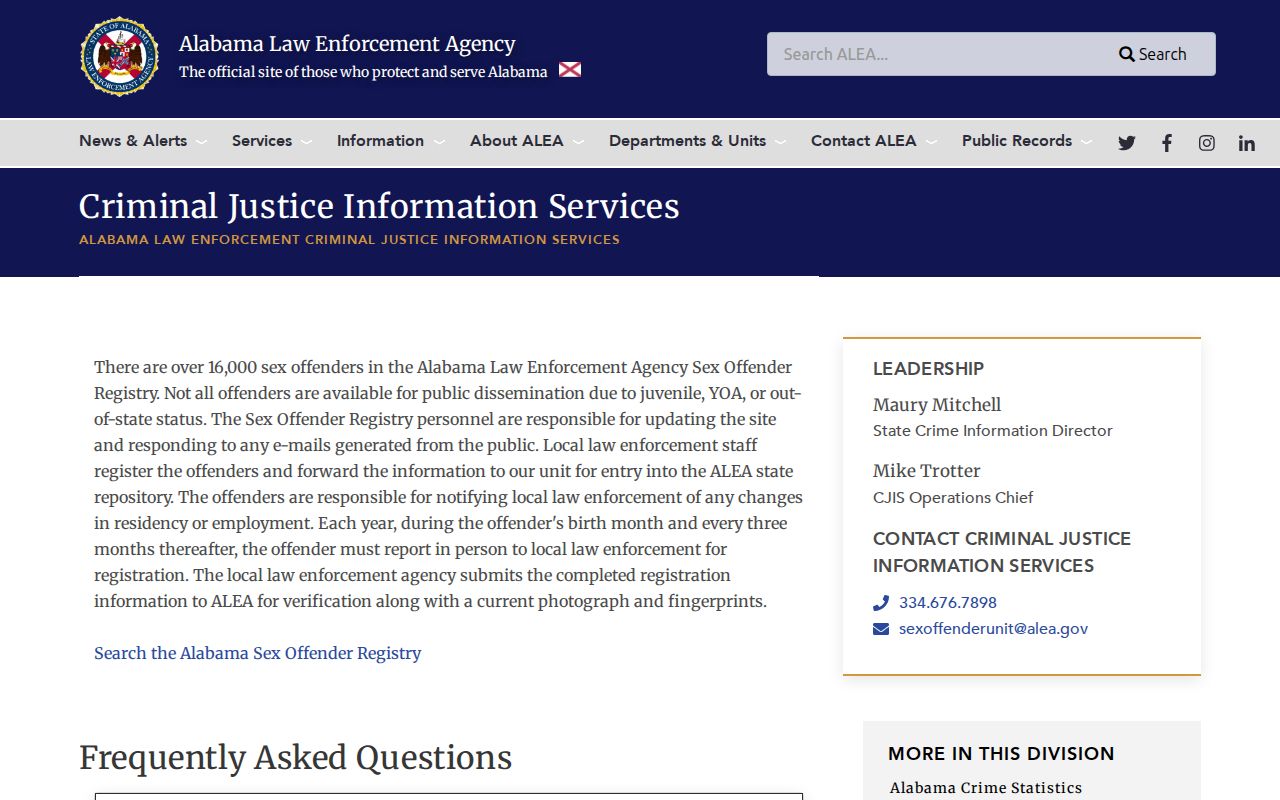
The FAQ helps interpret a Coffee County result because it separates public registry duties from the broader data gathered during registration.
Coffee County Registry Contact
The Coffee County Sheriff's Office does not publish a separate registry desk, special appointment line, registration fee, or appointment schedule. The verified local fallback is the main office and county jail complex at 1133 East McKinnon Street, New Brockton, AL 36351. Call (334) 894-5535 before traveling. Published public-office hours are Monday through Friday, 8:00 a.m. to 4:00 p.m. Ask whether the Sheriff is the responsible registering agency for the address and what identification or appointment steps apply.
This distinction matters inside incorporated places. ALEA describes registration as a local law-enforcement task, so a person in Enterprise, Elba, or New Brockton may need to confirm responsibility with the Enterprise Police Department, Elba Police Department, or New Brockton Police Department. Do not assume the New Brockton sheriff counter handles every city address in the same way. ALEA's Sex Offender Unit can answer state-program questions at (334) 676-7898 or sexoffenderunit@alea.gov, but immediate location or compliance concerns belong with local law enforcement.
Searching the Alabama Sex Offender Registry
ALEA's public registry supports both person-based and place-based searches. None of the core fields is identified as mandatory in the research inventory, so start with the narrowest reliable fact and widen only when needed. Spelling and alias differences may change a name result. For a Coffee County area check, combine the county filter with a city, ZIP code, or address-radius control when the live interface allows it. Exact radius choices can change and should be read from the portal at the time of the search.
- Open the ALEA-linked registry and read its conditions and statutory warning before searching.
- Enter a name, or choose Coffee County and add a city, ZIP code, address, or radius filter.
- Review possible matches by comparing the photograph, aliases, physical description, and location facts.
- Open the complete public profile and examine the offense, conviction, registration, and compliance details.
| Field Label | Type | Required | Notes |
|---|---|---|---|
| Last Name / First Name | Text | No | Spelling and aliases can affect matches. |
| City/Town | Text or list | No | Narrows results to a named place. |
| County | Dropdown | No | Select Coffee for county-level results. |
| ZIP Code | Text | No | Uses a five-digit area. |
| Address / Geographic Radius | Address and radius | No | Check the live portal for current radius choices. |
Coffee County and NSOPW Searches
The Alabama registry and the U.S. Department of Justice's National Sex Offender Public Website serve different geographic needs. ALEA is the primary source for Alabama profile and compliance data. NSOPW searches participating jurisdictions nationwide, making it a useful second step when a person may have lived, attended school, or registered outside Alabama. Neither search should replace careful identity matching or a direct report to law enforcement.
The national search screen shows the cross-state starting point available to Coffee County residents.
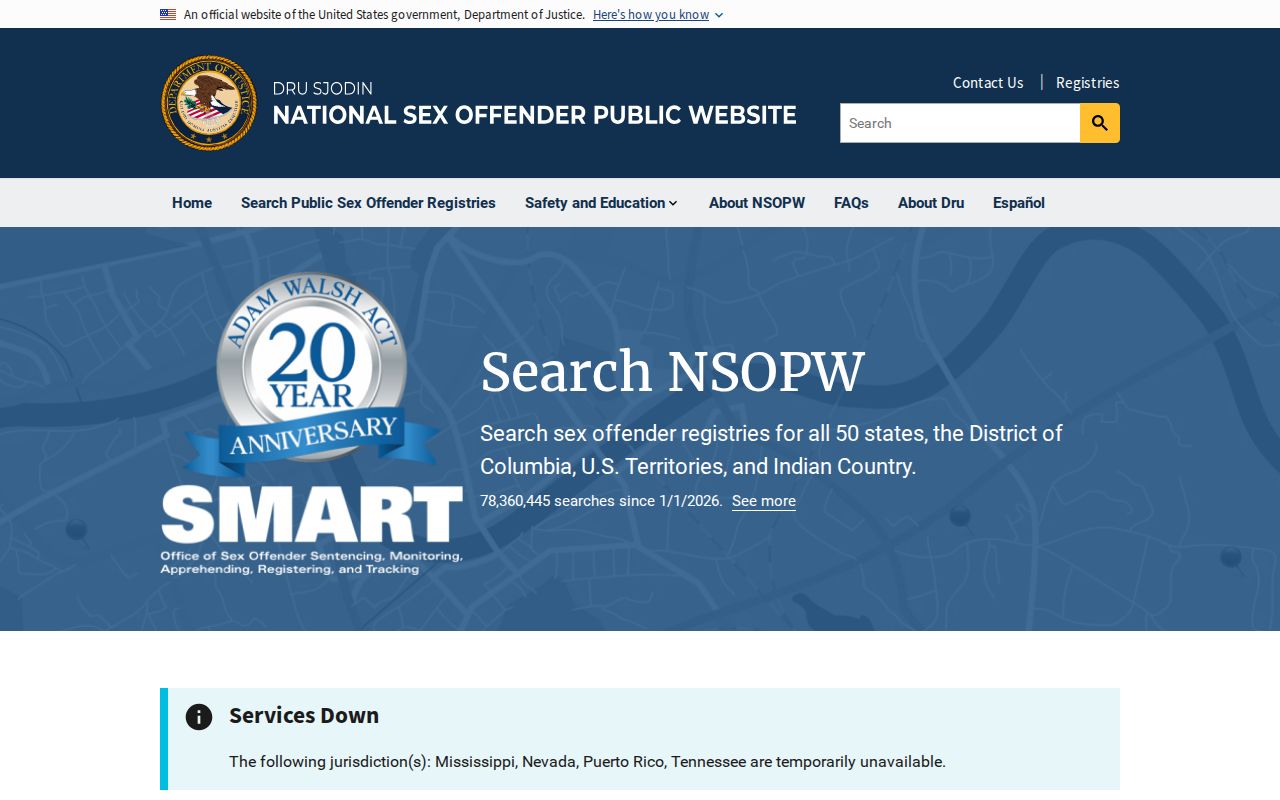
Use the national layer to widen geography, then return to the listing jurisdiction for the most direct public profile and local reporting channel.
What a Registry Profile Shows
Alabama Code §15-20A-8 defines the public categories. A Coffee County registry profile may show identity details, a current photograph, physical descriptors, residence information that the statute permits, qualifying offense and conviction facts, and registration or compliance status. That public view is narrower than the information collected under §15-20A-7. Registration records may also contain vehicle, school, work, Internet-identifier, fingerprint, palm-print, DNA, and travel data. Do not assume every collected item appears publicly or with the same level of detail.
| Name & Aliases | Public identity names used to compare a possible match. |
|---|---|
| Photo & Physical Description | Current image and physical facts that distinguish people with similar names. |
| Residence Information | Address or location information made public under Alabama law. |
| Offense & Conviction | Qualifying offense and conviction facts tied to the duty to register. |
| Public Category or Status | Offense- and status-based information, not a universal adult Level 1, 2, or 3 score. |
| Registration Status | Public compliance or registration information supplied through the statutory process. |
When Coffee County Results Are Missing
A missing name is not a universal clearance. ALEA states that only offenses listed in Alabama Code §15-20A-5 appear. Certain first indecent-exposure or sexual-misconduct matters may be treated differently. Juvenile, youthful-offender, out-of-state, and due-process categories can also affect whether and when a public listing appears. A spelling variation, alias, move, or pending update can change the result as well.
If a qualifying-looking Coffee County case does not appear, first repeat the name search with known aliases and then try a geographic search. Check NSOPW when another state is plausible. Court case records can show what charge and disposition were filed, but a court caption alone does not decide public registry eligibility. Report a suspected wrong address or noncompliance to the responsible local agency. ALEA says local law enforcement verifies addresses and sends changes onward.
The ALEA expungement overview shows that court-ordered record relief follows a separate legal process.
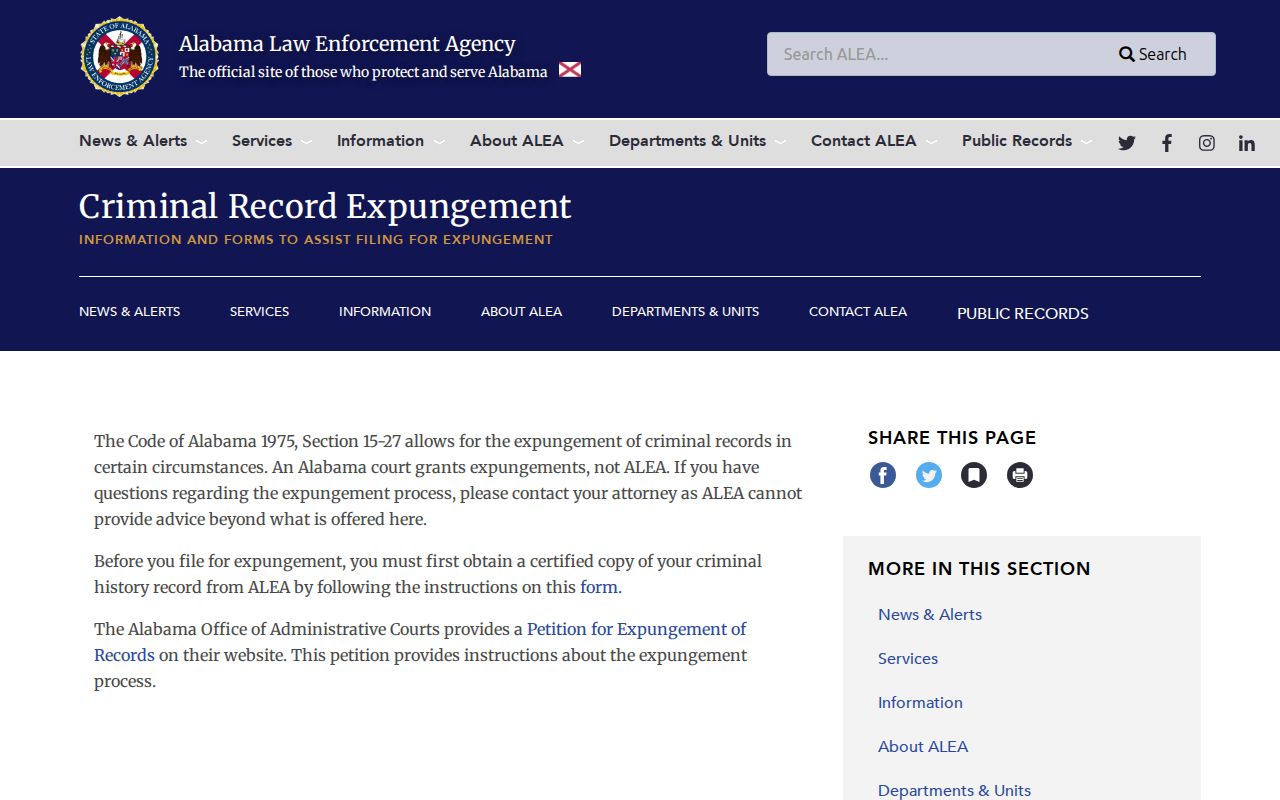
That separation helps prevent the mistaken view that a changed court record automatically answers every registry-status question.
Registration Requirements and Levels in Alabama
Alabama does not publish a simple adult risk ladder that labels every person Level 1, Level 2, or Level 3. The public system follows qualifying offenses and legal status under the Alabama Sex Offender Registration and Community Notification Act. Adult sex offenders generally register for life under §15-20A-3, subject to limited statutory petition paths. Adults report in person during the birth month and every three months after that, and they must report changes required by law. Section 15-20A-22 sets a $10 charge at each quarterly appearance or change.
Juvenile rules differ. Article 3 uses low, moderate, and high risk levels for notification. Duration is life for specified serious offenses adjudicated at age fourteen or older and generally ten years in other covered juvenile cases. The table preserves those Alabama categories without importing the federal SORNA 15-year, 25-year, and lifetime tiers as consumer-facing Alabama labels.
| Alabama Category | Duration | Reporting / Visibility |
|---|---|---|
| Adult qualifying offender | Generally lifetime, with limited statutory petition paths | In person during birth month and every three months thereafter; public listing depends on ASORCNA. |
| Juvenile low, moderate, or high risk | Generally ten years, or life for specified serious offenses adjudicated at age fourteen or older | Article 3 risk level governs notification; duties are not the adult public tier model. |
| Exception or nonpublic category | Depends on the statutory category and process | Some juvenile, youthful-offender, out-of-state, first-offense, or due-process situations may not display publicly. |
Coffee County Quarterly Reporting
Quarterly reporting is an ongoing local-to-state process, not a once-only enrollment. The person appears during the birth month and every three months afterward, reports covered changes, and supplies required updates. Local law enforcement then transmits changes, a current photograph, and fingerprints to ALEA. This flow explains why the local agency and state portal have connected but distinct roles.
Alabama also regulates residence, work, and loitering through §§15-20A-11 and 15-20A-13. Those rules should not be reduced to one blanket distance from every school or park. The relevant category, place, conduct, and current statutory text all matter. For a legal question about a particular restriction or petition, consult the current Alabama Code or an Alabama attorney. The public profile is a safety-awareness record, not a full account of all nonpublic registration data.
The Alabama Legislature provides the official Code interface for current ASORCNA text.
Reading the current statute keeps Coffee County reporting duties and restrictions tied to the correct legal category.
Coffee County Public and Nonpublic Data
A public profile is not the full registration file. Section 15-20A-8 controls public categories, while §15-20A-7 requires a broader set of registration details. Public-facing facts help with identity matching, location awareness, qualifying offense context, and compliance status. The agency-held file can reach vehicles, digital identifiers, biometrics, travel, school, and work information. Privacy and security rules still govern how those items are released.
This split also clarifies the Alabama Open Records Act. A general right to inspect public writings does not override ASORCNA's publication rules, protected identifiers, investigative limits, or other lawful restrictions. A request for a nonpublic field does not turn that field into public registry data. The state public-record request reference explains Alabama's broader records framework.
The public-record framework supports a narrow, source-specific approach instead of treating every registration detail as open data.
Lawful Use and Community Notification
Registry information supports personal, family, neighborhood, and community safety awareness. Search the state registry first, compare several identity facts, and use NSOPW when cross-state coverage matters. Do not rely only on a map marker. If an address looks wrong or a person appears noncompliant, give the concern to the Coffee County Sheriff or the responsible city police department. Local officers can verify information and forward a change to ALEA.
Public access carries strict limits. A listing does not authorize threats, harassment, intimidation, injury, vigilantism, or any other crime. It also does not prove facts beyond the public profile. Alabama Code §15-20A-8 requires search access and a warning about misuse. Keep any safety plan focused on lawful conduct and official reporting, not personal confrontation.
Misuse is a crime: Alabama Code §15-20A-8 warns against using registry information to injure, harass, or commit a criminal act. Suspected noncompliance should be reported to law enforcement, not confronted in person.